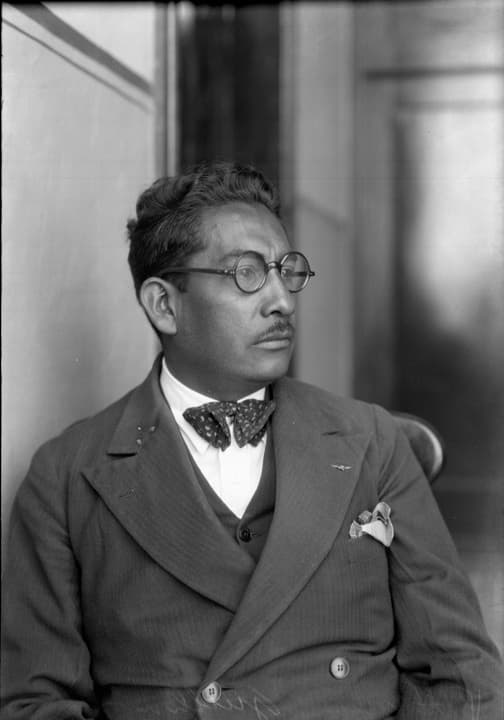
Joaquín de la Cantolla y Rico
1829–1914 · Mexican
Ballooning (pre-powered flight)
WHY YOU SHOULD KNOW THEM
Mexico's first aeronaut, known for his 1863 hot-air balloon ascent "Moctezuma I" and his 1867 flight of "Vulcano" over Mexico City
THEIR STORY
Joaquín de la Cantolla y Rico's path to becoming Mexico's first aeronaut began with military service: he studied at the Colegio Militar at Chapultepec Castle and fought in its defense during the 1847 U.S. invasion of Mexico, where a gunpowder accident cost him an eye and ended his military career. He went on to work as a telegraphist, a profession with no obvious connection to flight — until Benito León Acosta's 1842 balloon flight and the legacy of the Montgolfier brothers captured his imagination. In 1862, he apprenticed with the traveling balloonist Wilson brothers, learning the practical craft of ballooning. His breakthrough came in 1863, when he made a celebrated public ascent in a balloon he named "Moctezuma I" — a flight impressive enough that Emperor Maximilian personally recognized him with a gift of gold cufflinks. In 1867, he flew a second balloon, "Vulcano," more than 20 meters tall and decorated with an eagle emblem matching Mexico's national flag, over Mexico City itself. His contributions went beyond simply flying: he invented a system to regulate the flame under a hot-air balloon to control its rate of ascent and descent — a real technical improvement to balloon flight safety and control — and founded the Empresa Aerostática de México, an early aviation-adjacent business enterprise. His legacy persists today in an unexpected, charming way: small paper hot-air balloons called "globos de Cantolla," still released at Mexican festivals and celebrations, are named directly for him, and Mexico holds annual balloon competitions in his honor. He also appears in murals by the painter Diego Rivera, a mark of his lasting place in Mexican cultural memory.
WHAT THEY ACTUALLY DID
As a balloon pilot and inventor, Cantolla y Rico built and flew hot-air balloons and invented a flame-regulation system to control ascent and descent — genuine engineering problem-solving applied to the earliest form of controlled human flight.
WHAT YOU'RE LEARNING THAT CONNECTS
Balloon flight relies on the same basic principle of buoyancy and heated-air density that students encounter when first learning why and how anything heavier than air can be made to rise — a genuinely different mechanism from the wing-based lift covered in aerodynamics lessons, worth understanding by contrast.
DID YOU KNOW?
Small paper hot-air balloons called "globos de Cantolla," still released at Mexican festivals today, are named directly after him.He appears in murals by the painter Diego Rivera.
SOURCES
Wikipedia (Spanish); El Historiador; Kiosco de la Historia
Photo: Fototeca Nacional, INAH · CC BY-NC-ND 4.0 · Source