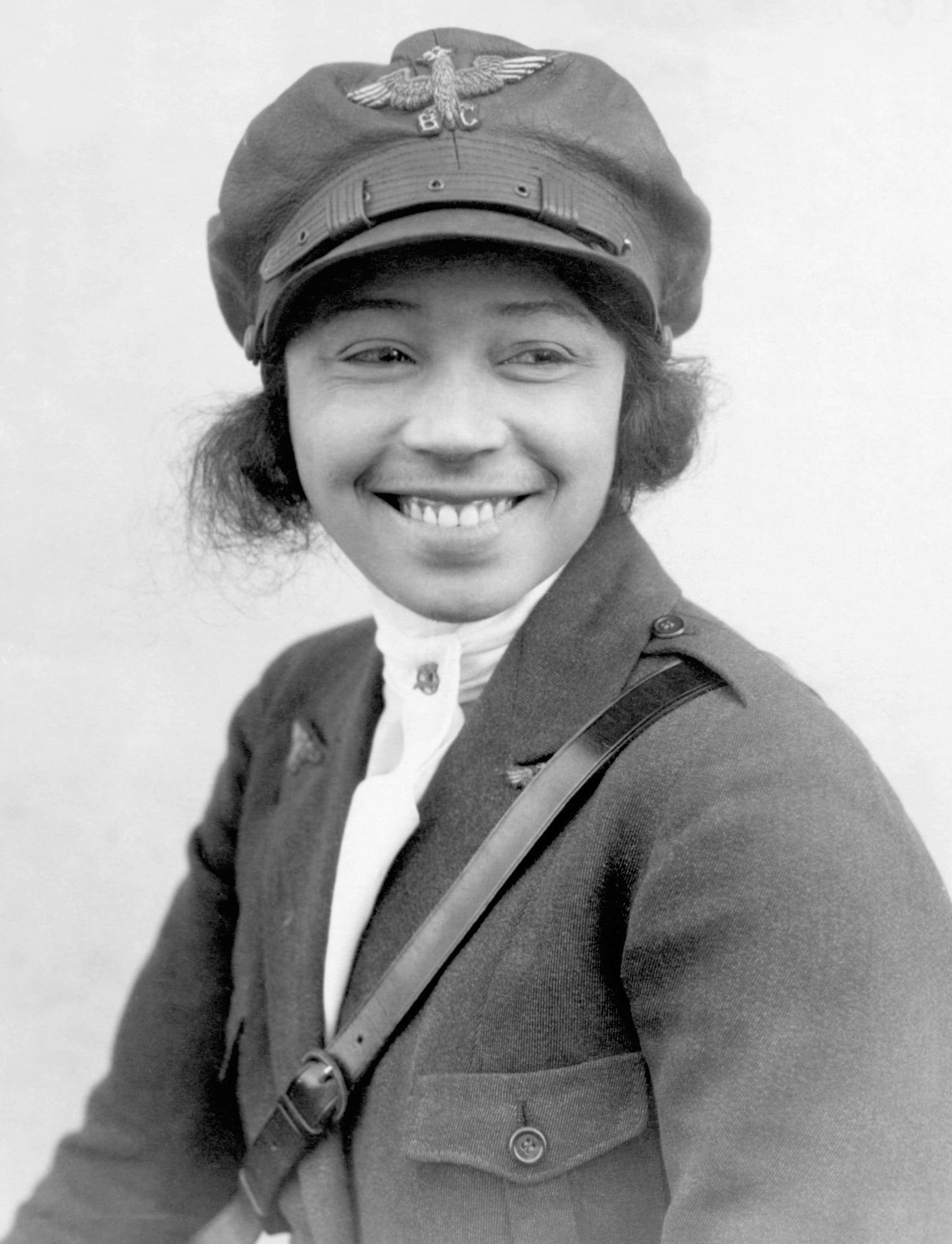
Bessie Coleman
1892–1926 · American
Civil aviation — exhibition/stunt flying
WHY YOU SHOULD KNOW THEM
First African American woman, and first Native American woman, to hold a pilot's license (1921)
THEIR STORY
Bessie Coleman was one of thirteen children born to a domestic worker and a day laborer in Atlanta, Texas. Her father was of Choctaw and Cherokee Native American heritage in addition to Black heritage, making Coleman both African American and Native American — a fact that makes her a genuine "first" in both categories at once. She moved to Chicago in 1915, where she worked as a manicurist, and it was her brother's stories about French female pilots he'd encountered during World War I that first sparked her interest in flying. There was no path into aviation training for her in the United States — no flight school would train a Black woman. So she did something few people in her position could manage: she saved money, learned French, and traveled to France, completing a ten-month aviation course — covering tail spins, banking, and looping — at the École d'Aviation des Frères Caudron. On June 15, 1921, the Fédération Aéronautique Internationale issued her a pilot's license, making her the first African American woman, and the first Native American woman, to hold one. She returned to the United States in September 1921 and built a career as an exhibition and stunt flyer — loops, figure eights, aerobatic maneuvers performed for paying crowds, which was also how the broader aviation industry built public excitement and legitimacy in that era. She was also a person of real principle: she refused to perform for segregated audiences, using what leverage her fame gave her to push back against the discrimination she'd already faced getting into the sky at all. Her real ambition was to open a flying school specifically for African Americans, giving others the training opportunity she'd been denied at home — a goal she never got to complete. She died on April 30, 1926, in a test-flight accident in Jacksonville, Florida: a wrench left in the aircraft jammed the controls, and she wasn't wearing a seatbelt because she was leaning out to scout the ground for an upcoming parachute jump. She was thrown from the aircraft. Her legacy has only grown since: she received the Congressional Gold Medal in 2023, nearly a century after her death, and a 2023 U.S. quarter also honors her.
WHAT THEY ACTUALLY DID
As an exhibition and stunt pilot, Coleman flew loops, figure eights, and other aerobatic maneuvers for public audiences — dangerous, skill-intensive flying that also happened to be how the aviation industry itself built public trust and excitement in its earliest years.
WHAT YOU'RE LEARNING THAT CONNECTS
Aerobatic maneuvers like loops and spins push an aircraft's aerodynamics — lift, angle of attack, load factor — well past normal flight, exactly the kind of edge-of-the-envelope flying that aerodynamics lessons explain the physics behind.
DID YOU KNOW?
She received the Congressional Gold Medal in 2023, nearly a century after her death.She was both the first African American woman and the first Native American woman to hold a pilot's license, due to her mixed Black and Choctaw/Cherokee heritage.
SOURCES
Smithsonian National Air and Space Museum; Smithsonian Institution; Smithsonian Magazine
Photo: Unknown · Public domain · Source