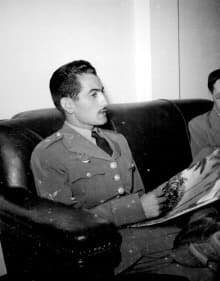
Radamés Gaxiola Andrade
1915–1966 · Mexican
Military aviation — fighter squadron command
WHY YOU SHOULD KNOW THEM
Commanded Escuadrón 201 during its Philippines combat deployment in World War II
THEIR STORY
Radamés Gaxiola Andrade grew up partly in the United States, which gave him fluent English — a skill that would matter more than he could have guessed. He entered Mexico's Military College in 1932 and graduated as an infantry lieutenant in 1935, then moved into aviation, training first at Mexico's Military Aviation School and then, in 1939, at Randolph Field in Texas, where he earned an honorable mention. He spent the early 1940s as a flight instructor, teaching the next generation of Mexican military pilots. In 1944, as World War II ground on, the United States War Department invited Gaxiola and General Gustavo Salinas to travel to the Normandy front as official observers — an unusual honor, and Gaxiola was the only Mexican Air Force pilot who actually flew in combat operations during that campaign. That firsthand experience of a real air war shaped what came next: when Mexico organized Escuadrón 201, its only unit to fight abroad, Gaxiola was named commander, and he pushed hard for the squadron to be given genuine combat missions rather than a ceremonial or purely symbolic role. He got his wish. Escuadrón 201 deployed to the Pacific in 1945 and flew combat missions over Luzon in the Philippines, supporting the Allied campaign to retake the islands from Japanese occupation, flying P-47D Thunderbolts in close coordination with the U.S. Army Air Forces. Gaxiola led the squadron through that deployment, and Mexico's only wartime combat unit came home with real operational experience under his command. His career continued to rise after the war: promoted steadily through the ranks, he became Chief of Air Services for Mexico's Treasury Department in the late 1940s, and later served as a deputy chief of the presidential staff. He was decorated by multiple countries for his wartime service, including a Far East Service medal, Mexico's Legion of Honor, a Philippine presidential decoration, and the U.S. Air Medal. He died in 1966 in an aviation accident near Guerrero, still an active pilot even after decades of service. A street in Mexico City's Iztapalapa borough carries his name today.
WHAT THEY ACTUALLY DID
As a squadron commander, Gaxiola wasn't just a pilot — he was responsible for training standards, mission planning, and fighting for his unit to be trusted with real combat responsibility rather than a symbolic assignment, then leading that unit through actual air-to-ground combat operations over Luzon.
WHAT YOU'RE LEARNING THAT CONNECTS
Escuadrón 201's deployment is one of the clearest real examples of military aviation as a coordinated system — pilots, ground crew, radio operators, and command structure all had to function together for the unit's combat missions to succeed.
DID YOU KNOW?
He was the only Mexican Air Force pilot to fly combat missions during the Normandy campaign, as an official U.S.-invited observer.He was personally selected alongside General Gustavo Salinas Camiña to represent Mexican military aviation to the U.S. War Department.
SOURCES
SEDENA official biography; América Vuela; Spanish Wikipedia
Photo: Fototeca Nacional, INAH · CC BY-NC-ND 4.0 · Source